

Speechless
For Once

During my first few years of driving, there wasn’t an inanimate object I didn’t love tap with my mom’s Toyota Highlander. I reversed into garage doors, parked cars and most destructively, a mailbox. I braked so hard after hitting this mailbox that a crate in the trunk flew against the rear window and shattered it. The street and trunk of my car were flooded with glass. Shocked, I drove down the block before being struck with guilt and shame. I am not a hit and runner!

I pulled the car over and called my friend whose family mailbox I’d railed into. The family had just gone on a walk. I asked what I should do. There was the muffled sound of my friend telling her parents. My heart flopped like a dead fish in my stomach. “We’ll take care of it when we get back. Just leave it,” she said. And I did.
Hands at ten and two, I drove home sobbing. My conscious thrashed around about whether or not I should drive back and stand in the street to help when they got back from their walk, but I didn’t. I felt very guilty and I did nothing productive with this guilt.
There are things that you learn in school that are plastered on your brain for life: the assembly guest speaker with no legs who walked around on his hands, that energy cannot be created or destroyed and that a girl named Kitty Genovese was stabbed to death and none of her neighbors called the police, which is the example they used to teach us about the Bystander Effect. The lesson was effective because since then, I have been terrified of saying nothing while bad things happen.
To be clear, I do not think that posting on social media is the only way to prove that you care about a cause. In fact, I never post about important causes on social media. Human rights? Children’s literacy? Not on my feed. I like posts from my favorite politicians and change makers and that’s as far as I go. There’s got to be a safe space to assert your hotness and force your Substack on people. Instagram is that place for me. Real life is where I have my serious conversations and vote.

More gripping for me than the question of whether or not to post an infographic to your IG story is the question of why it is so hard to speak up and take action in real life. Not just on the big and obviously bad stuff, but more often on the small. It’s been over a decade since I left glass in the street, but I still feel bad about it. A few months ago, in pursuit of my second cup, I noticed that the office coffee machine was dripping onto the countertop as the pot filled with freshly brewed coffee. I clocked this information, pivoted and left the mess for someone else to deal with. Three steps from the door, I started feeling bad about leaving the coffee dripping, but turning around would be an admission that I’d noticed in the first place and done nothing. I waffled and then left. I’ve spent three months feeling bad about it and am now memorializing my guilt online. Still, I have apologized to no one.
Saying the right thing in the right moment is easier said than done. Real life contains gray area. It’s not all so cut and dry as your neighbor Kitty Genovese getting stabbed in the shared courtyard while you turn up the volume on Gilligan’s Island and heat your Swanson’s Salisbury Steak (she was murdered in 1964). In real life, there are relationship tensions at stake. The high and mighty aren’t trusted with juicy confidences. No pot wants to divulge their inner thoughts over dirty martinis to the crispy kettle.

Challenge presents itself when someone you love/care about/have to get along with says something that isn’t so severely wrong as to be decidedly sexist/racist/dealers choice of fucked up, but that doesn’t sit right with you. My stomach clenches at what was said, but I also don’t want to alienate my interlocutor. I don’t believe that jumping down someone’s throat for saying the wrong thing is helpful to anyone. That sort of response makes me want to smack my fellow progressive on the shoulder and whisper through gritted teeth, “Shut up. We’re losing them.” On the flip side, when I stay quiet because I don’t know how to say something without killing the vibe or misrepresenting my stance, I berate myself and sometimes deserve it.
In her book The Unthinkable: Who Survives When Disaster Strikes - and Why, Amanda Ripley describes that one common theme among people who survive catastrophic events is that they were prepared to act. These are the sorts of people who look for emergency exists before the plane takes off or before the movie starts at the theater. They are able to take action when things go haywire because they prepared in advance in some small way. Similarly, we can’t count on ourselves to say or do the right thing if we’ve never paused to think about our value system and how to express it. If you want to be the sort of person who speaks up when it’s appropriate, then perhaps it’s worth thinking in advance about what you might say. Unless you’re the sort of freak who ad libs speeches on the fly, expecting yourself to say the right thing in the moment without practice is probably unrealistic.
And my greatest bar yet: They say if you shoot for the moon, you may fall among the stars. Today, I am resolving to speak up more often when I should. In practice, this will likely change my behavior by a fraction, but I think that fraction matters.
I am starting small with the following practice run.
I get the tense / clenched / ahh should I say something feeling when someone who I care about says something that I feel has an undertone of misogyny. Not “shut up, piggy,” not even a tenth of “shut up, piggy,” but not so Gloria Steinem either. One that pops up all the time is the description of a woman (actress, influencer, normie) as “shallow.” My gut feeling when I hear this is irritation, but I have never articulated why. So, here is the scratchpad response that I’m working through:
I don’t know that I actually believe a person with full cognitive function can be shallow. Shallow means “having little depth” and “lacking in depth of knowledge, thought, or feeling.” As I see it, to treat a person as wholly human, you must acknowledge the richness of their inner world whether it makes sense to you or not; whether you agree with their value system or not. If you’re going to rip some girl apart for posting selfies and buying expensive clothes —don’t— but if you do, then at least give her the respect of assuming she did so actively and with initiative. Vain, materialistic, greedy, self-absorbed— whatever you’re going to say, give your criticism some backbone! Some motivation!
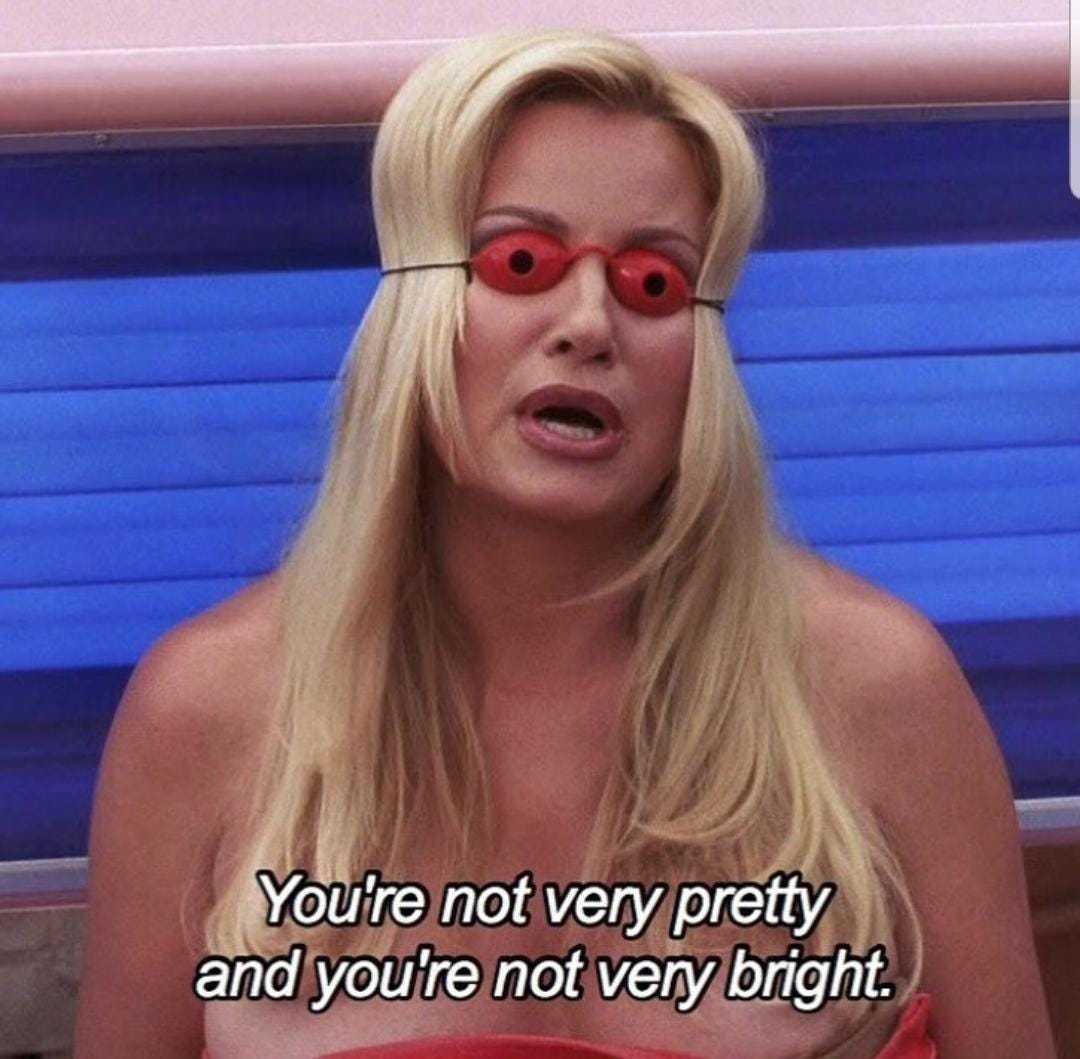
Talking shit is a shitty thing to do, but also maybe developed as an evolutionary necessity for people to establish shared values as a society and to evaluate whether or not members of the collective were acting in accordance with these values. Minimally, it’s not something most of us are going to stop doing any time soon. I’m just asking that shit talk about women doesn’t take them out at the kneecaps by implying a lack of depth of thought. Make it a fair fight.
Ooookay work in progress. Not sure about that one, but aren’t you glad I haven’t said it in conversation against an unsympathetic opponent yet?
Thank you for letting me try it out on you!
Giggling
The pics are always too good es <3